


2. Detect a signature (SBS3, APOBEC, any other)
Score one mutational signature in your own panels or exomes with run(), and handle what it refuses.
Before you begin, you need the package installed, a MAF, VCFs or an SBS-96 matrix, the tumor type and platform of your cohort.
sg2.run() scores one signature in a set of tumors. You give it the mutations, the tumor type, the signature and the platform; it finds the trained classifier for that combination, checks that the classifier may be used, and returns a table with one row per tumor. The signature is any of the catalog: Signature 3, APOBEC, SBS8, SBS18, a composite. HRD and mismatch repair have calls of their own:
- Does a tumor carry a mutational signature? Any signature of the catalog: SBS3, APOBEC, SBS8, SBS18, UV, …
run(soi="APOBEC")this guide - Is a tumor homologous-recombination deficient?
run(soi="HRD", segments=…)3. Detect HRD - Is mismatch repair deficient, or POLE mutated?
predict_mmrd_ppd()4. Detect MMRD or POLE
Get the example file
curl -LO https://raw.githubusercontent.com/parklab/SigMA/master/inst/extdata/examples/test_mutations_50sample.maf
Run the classifier
import sigma2 as sg2

out = sg2.run(
    input="test_mutations_50sample.maf",
    ref_genome="hg19",
    tumor_type="breast",
    seq_type="msk",
    soi="SBS3",
)
out.df
| Parameter | Description | Default |
|---|---|---|
| inputpath, list of paths, folder or DataFrame | The mutations: a MAF path, a VCF path, a list of VCF paths, a folder of VCFs, a CSV, or a DataFrame of SBS-96 counts. | Required |
| ref_genomestr or path | The build of the coordinates (hg19, hg38, GRCh37, GRCh38) or a FASTA path; unused for a matrix input. | 'hg19' |
| tumor_typestr | A tumor type of the vocabulary, in any case (the package lists 39 names; msi and pole among them are signature sets, not tumor types); it sets the signature set, the reference spectra and the classifier. | Required |
| seq_typestr | The platform (msk, fo, op, seqcap, tcga_mc3, wgs); "auto" chooses by SNV burden and reports the choice. | 'auto' |
| soistr or CompositeSignature | The signature of interest: a COSMIC name, a composite preset (APOBEC, SBS7, SBS10, SBS17, CLOCK), an alias (UV, POLE), or HRD. | Required |
Look at the result
The package draws the cohort as stacked exposures sorted by the signature's share, and any one panel as its spectrum:
from sigma2 import plot as sp

sp.exps(out.df, soi=sg2.resolve_signature("SBS3"), path="exposures.svg", show_sample_names=False)
top = out.df["SBS3_mva"].idxmax()
row = out.df.loc[top]
sp.sbs(
    out.df.loc[[top]].iloc[:, :96],
    title=f"{top}: Signature 3 score {row['SBS3_mva']:.2f}, {row['confidence']}",
    path="top.svg",
)
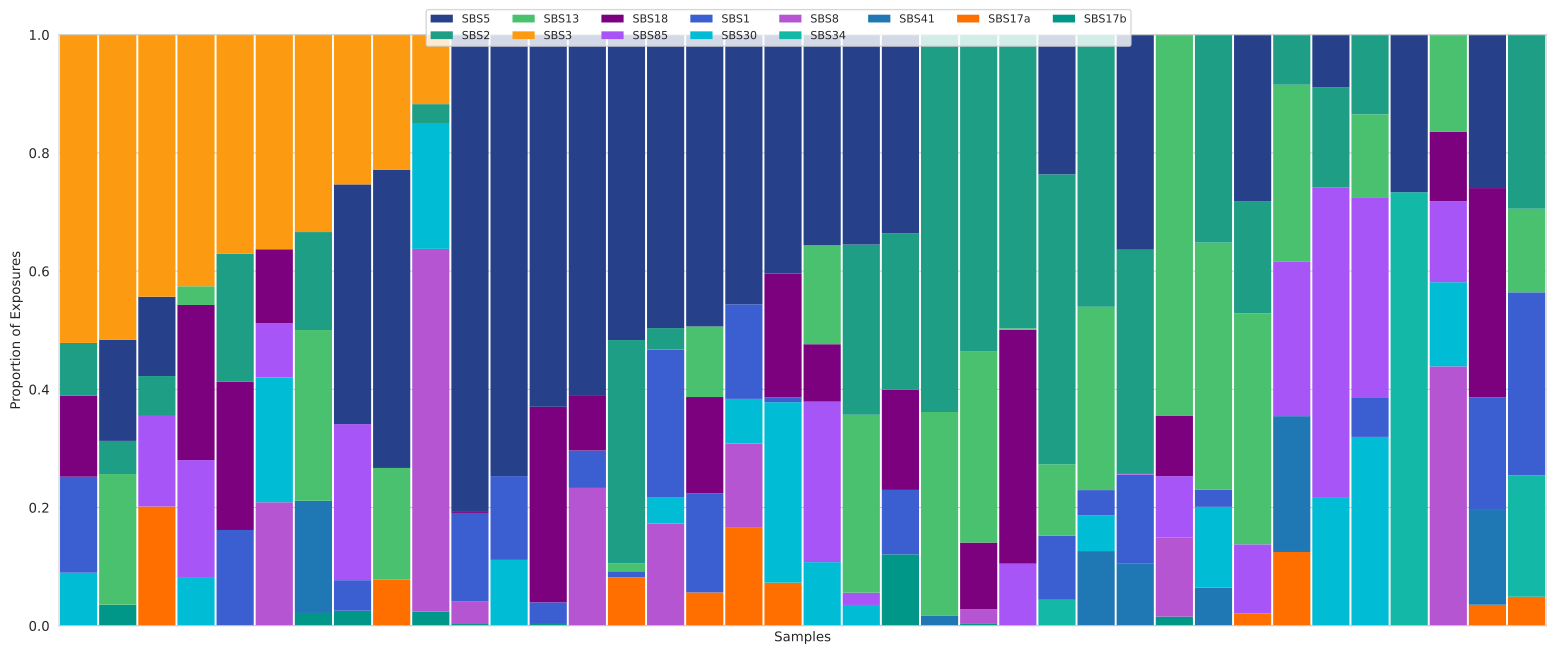
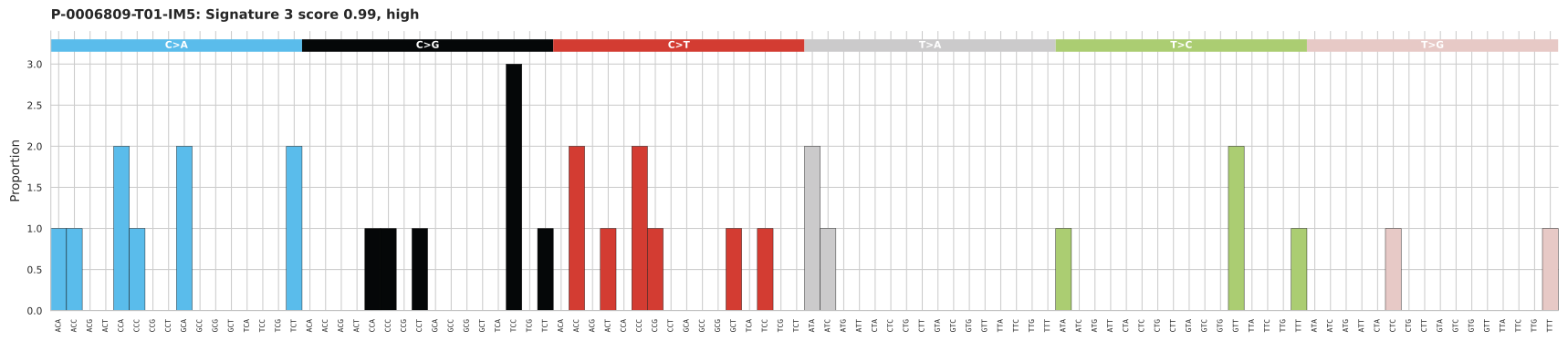
6. Plot spectra and exposures has both functions in full.
Check what the panel delivered
A call needs the signature's own mutations on the panel, and most panels hold few. exp_SBS3 in the result is the count the decomposition attributed to Signature 3 in each panel, the package's assigned burden; a panel at zero gave the classifier nothing of the signature:
cols = ["total_snvs", "exp_SBS3", "SBS3_mva", "confidence"]
burden = out.df[cols].sort_values("exp_SBS3", ascending=False)
print(burden.describe().loc[["50%", "mean", "max"]])
none = int((out.df["exp_SBS3"] == 0).sum())
print("panels with no Signature 3 mutation attributed:", none, "of", len(out.df))
      total_snvs   exp_SBS3  SBS3_mva
50%         11.0   0.000000  0.141468
mean   18.289474   2.120242  0.321848
max        104.0  21.509469  0.991699
panels with no Signature 3 mutation attributed: 28 of 38
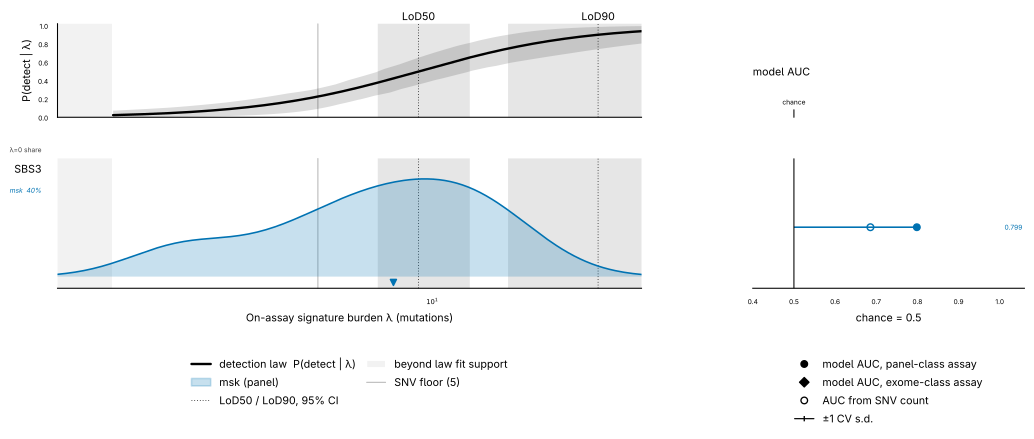
On this cohort, 28 of 38 scored panels gave the classifier no Signature 3 mutation to read, and those are where a true positive is missed. Most calls sit at the top of this list; four loose calls come from panels with no Signature 3 attributed, on the likelihood of the breast Signature 3 reference spectra alone, and deserve a look at the spectrum. A negative call on a panel is weak evidence of absence, so a count of calls is not the signature's prevalence in the cohort. The expected count behind that, the signature's share times the panel's SNVs, is the quantity the package's detection law is fitted on; When a call is possible says what it means for a cohort, and on your own training the package draws the law and your positives' burdens against it:
from sigma2 import plot as sp

sp.dtc("cohort/results", tumor_type="breast", output="detectability.svg", n_boot=100)
Check the calls before you report them
- Hypermutated tumors. A signature run does not look for mismatch-repair deficiency or a POLE defect. Run
predict_mmrd_ppd()on the same file: a Signature 3 call on a tumor it callsMMRDorPOLE, here the loose call on P-0007087, is read off a spectrum another process shaped. A Signature 3 call on a panel dominated by APOBEC mutations deserves the same look. - How the cell was released. 39 breast, lung and skin cells were released before the release gate, among them breast APOBEC, SBS8 and SBS18 on MSK-IMPACT: their calls carry no evidence grade and no
call_evidencecolumn (release status).
Choose the arguments
input, tumor_type and ref_genome are what the table says. Beyond it: every SNV in a VCF counts whatever its FILTER, so filter to PASS before scoring (Prepare your input files); the tumor type sets the signature set, the reference spectra and the classifier, so a wrong one gives a wrong answer without an error, and a tumor type without a signature set in the catalog fails early with an error naming it (the vocabulary lists all 39); a MAF's NCBI_Build is checked against ref_genome, and a matrix input needs none (genome builds). The platform and the signature take more:
Choose the platform with seq_type
The platform the tumors were sequenced with. Pass it whenever you know it:
seq_type | Platform |
|---|---|
msk | MSK-IMPACT |
fo | FoundationOne |
op | OncoPanel (v3) |
seqcap | SeqCap EZ Exome v3 |
tcga_mc3 | TCGA MC3 exome (GENCODE v19 basic) |
wgs | whole genome |
Names match in any case. seq_type="auto" picks, among the platforms with a classifier for this tumor type and signature, the one whose training cohort's median SNV count is closest to your input's, and reports the choice:
out = sg2.run(
    input="test_mutations_50sample.maf",
    ref_genome="hg19",
    tumor_type="breast",
    seq_type="auto",
    soi="SBS3",
    verbose=1,
)
seq_type="auto" chose "msk": the input's median is 8 SNVs, the msk classifier's training median 9
(others: seqcap 36, tcga_mc3 189, wgs 4310). Burden cannot tell panels of similar size apart;
pass seq_type= when the platform is known.
Panels of similar size (msk, fo, op) have similar burdens, so auto cannot tell them apart. A custom panel has no name in the vocabulary: score it as the closest bundled platform and report it as such.
Choose the signature with soi
The signature of interest: a COSMIC name (SBS3, SBS8, SBS18, …), a composite (APOBEC for SBS2 and SBS13, SBS7 for SBS7a to d, SBS10 for SBS10a to d, SBS17 for SBS17a and b, CLOCK for SBS1 and SBS5), an alias (UV for SBS7, POLE for SBS10), or HRD for the HRD classifier (Detect HRD). Any case. One signature per run; for several, loop over the cells:
from sigma2 import classifiers

calls = {}
for card in classifiers.cards(tumor_type="breast", seq_type="msk"):
    if card.kind != "signature" or card.status == "experimental":
        continue
    out = sg2.run(input="test_mutations_50sample.maf", ref_genome="hg19", tumor_type="breast",
                  seq_type="msk", soi=card.classifier)
    calls[card.classifier] = out.df[[
        f"{card.classifier}_mva",
        "pass_mva",
        "pass_mva_strict",
    ]]
| Parameter | Description | Default |
|---|---|---|
| tumor_typestr | Keep the cards of this tumor type. | None |
| seq_typestr | Keep the cards of this platform. | None |
Choose which classifier runs
model="auto" (the default) takes the released classifier for the tumor type, signature and platform. The run names it:
Classifier: tumor_type="breast", soi="SBS3", seq_type="msk" (verified)
Using classifier: breast/SBS3/msk
verified means the stored weights match their recorded checksum. The alternatives:
model= | Runs |
|---|---|
"auto" | the released classifier, or a refusal |
"legacy" | SigMA v1's classifier for the cell, ported to Python; see Reproduce SigMA v1 |
| a loaded classifier | sg2.model("breast/SBS3/msk"), or one from your own store: sg2.model("breast/SBS3/msk", root_dir="shared_store"). Its reference spectra are passed with it. |
m = sg2.model("breast/SBS3/msk")
out = sg2.run(
    input="test_mutations_50sample.maf",
    ref_genome="hg19",
    tumor_type="breast",
    seq_type="msk",
    soi="SBS3",
    model=m,
)
model is called with its defaults. All parameters of model
Handle a refusal
No classifier for the cell. The tumor type has no classifier for that signature on that platform. The error lists the platforms that have one and says when SigMA v1 covers the cell:
try:
    sg2.run(
        input="test_mutations_50sample.maf",
        ref_genome="hg19",
        tumor_type="breast",
        seq_type="seqcap_probe",
        soi="SBS3",
    )
except ValueError as e:
    print(e)
No classifier for tumor_type="breast", soi="SBS3", seq_type="seqcap_probe".
  breast SBS3 has one on: fo, msk, op, seqcap, tcga_mc3, wgs.
  SigMA v1 has one for this cell: pass model="legacy".
  sg2.describe() lists every classifier.
classifiers.cards(tumor_type=...) returns the same list as data.
An experimental classifier. The only classifier for the cell was withheld by the release gate:
try:
    sg2.run(
        input="test_mutations_50sample.maf",
        ref_genome="hg19",
        tumor_type="prost",
        seq_type="op",
        soi="SBS3",
    )
except ValueError as e:
    print(e)
the only classifier for tumor_type="prost", soi="SBS3", seq_type="op" is EXPERIMENTAL: withheld by the
release gate (...). Pass force=True to use it anyway; its scores rank samples, but pass_mva and the
confidence labels from it are not supported.
With force=True the run returns <soi>_mva and leaves pass_mva, pass_mva_strict and confidence as NA. The score ranks the samples of your cohort; there is no validated cutoff and no call.
A catalog the classifier was not trained on. Without catalog=, the classifier's own catalog is used. Another catalog produces a warning that the scores are not the validated ones. A catalog that lacks the signature of interest, or that has no signature set for the tumor type (cosmic_v2), is refused. Floor, cutoffs and catalog has the rule.
A tumor type the HRD model cannot score. run(soi="HRD") refuses, with the reason, the tumor types its model saw in training but has no signature set for. Detect HRD lists them.
Optional: run without the classifier
mva=False skips the classifier and returns the features: the likelihoods under the tumor type's reference spectra, the cosine similarities, and the decomposition with the signature's exposure and share. No score, no call. It runs for any signature of the catalog and any tumor type with a signature set, with or without a trained cell, and takes the catalog by name:
feats = sg2.run(
    input="test_mutations_50sample.maf",
    ref_genome="hg19",
    tumor_type="breast",
    seq_type="msk",
    soi="SBS8",
    mva=False,
    catalog="cosmic_v3p2_inhouse",
)
feats.df[["total_snvs", "SBS8_c", "SBS8_l_rat", "exp_SBS8", "rat_SBS8"]].head(3)
The working columns explains each. assign=False leaves the likelihood assignment out as well.
Reference: every argument
Every argument of run(), including the ones the examples above do not pass:
| Parameter | Description | Default |
|---|---|---|
| inputpath, list of paths, folder or DataFrame | The mutations: a MAF path, a VCF path, a list of VCF paths, a folder of VCFs, a CSV, or a DataFrame of SBS-96 counts. | Required |
| tumor_typestr | A tumor type of the vocabulary, in any case (the package lists 39 names; msi and pole among them are signature sets, not tumor types); it sets the signature set, the reference spectra and the classifier. | Required |
| seq_typestr | The platform (msk, fo, op, seqcap, tcga_mc3, wgs); "auto" chooses by SNV burden and reports the choice. | 'auto' |
| soistr or CompositeSignature | The signature of interest: a COSMIC name, a composite preset (APOBEC, SBS7, SBS10, SBS17, CLOCK), an alias (UV, POLE), or HRD. | Required |
| modelstr or GBMModel | Which classifier runs: "auto" for the released cell, "legacy" for SigMA v1's, or a model loaded with sg2.model(). | 'auto' |
| snv_ctfint | The SNV floor below which a sample is not scored; left out, the classifier's recorded floor applies. | None |
| mvabool | False skips the classifier and returns the features only. | True |
| assignbool | False skips the likelihood assignment. | True |
| msibool | SigMA v1's MSI features on a signature run; for MMRD/POLE calls use predict_mmrd_ppd. | False |
| wcfbool | SigMA v1's msk_cf classifier with the cluster-size prior, on msk with model="legacy". | False |
| readjustbool | Re-derive the cutoffs for the batch's sequencing depth from the classifier's held-out negatives; for cohorts only. | False |
| verboseint | 0 prints errors and some warnings (a catalog other than the classifier's, a readjust without a table); 1 also prints the classifier, the sample counts and the other warnings, such as a legacy classifier's features passed as missing; 2 also lists the samples below the floor. | 0 |
| mxwint or str | The worker count for the decomposition and the HRD pre-step; "max" uses every core. | 1 |
| ref_genomestr or path | The build of the coordinates (hg19, hg38, GRCh37, GRCh38) or a FASTA path; unused for a matrix input. | 'hg19' |
| catalogstr | The signature catalog for the decomposition; left out, the classifier's own is used, and a different one warns or refuses. | None |
| forcebool | Score with an experimental classifier; the scores rank the cohort and every call column is NA. | False |
| namestr | A label for the run, carried on the output. | None |
| segmentspath or DataFrame | Copy-number segments for HRD: a path or DataFrame in a recognized format, with a sample column. | None |
| gisSeries or dict | Precomputed genomic instability per sample for HRD, as a Series or dict, when segments are not available. | None |
| indelspath, VCF, MAF or DataFrame | Indels from a separate source for HRD: a path, a VCF or MAF object, or a DataFrame. | None |
| bedslist of BED | Repeat-locus BED files of another build for the microsatellite indel counts. | None |
| hrd_modelstr or HRDModel | Another HRD model than the platform's, by name or as an HRDModel. | None |
| hrdbool | Add the HRD features to a signature run. | None |
Internal parameters (4)
| min_del_sizeint | Internal: the smallest deletion counted for the indel features. | None |
| min_mh_sizeint | Internal: the smallest microhomology counted as microhomology-mediated. | None |
| tumor_catalogDataFrame | Internal: the reference spectra the likelihoods are computed against; a loaded model passes its own. | None |
| cluster_fractionsDataFrame | Internal: SigMA v1's cluster-size prior table. | None |
Full signatures and types: Python API.
Read the result object
out.df is the table: the 96 channels, total_snvs, the decomposition features, the score and the calls, one row per scored sample. out.to_lite() returns the columns a reader needs as a DataFrame. out.snv_floor, out.catalog_name, out.seq_type, out.soi and out.model record what ran. Read the output describes every column.