

SigMA detects the homologous-recombination-deficiency signature SBS3 in targeted gene panels. It models the expected mutational background from whole-genome data, then combines likelihood, cosine similarity and NNLS exposure features in a gradient-boosting classifier trained on panel-downsampled genomes, recovering SBS3 from as few as ten panel mutations.
Targeted gene panels are the standard assay in clinical oncology, but a 1.7 Mb, 410-gene panel reduces the mutation count roughly 1,000-fold relative to whole-genome sequencing. Sig3-positive tumors retain an average of about eleven SNVs, and in a panel study of 10,000 patients signature analysis was feasible only for the 6% of samples with the highest mutational burden. SigMA detects Signature 3, associated with homologous-recombination deficiency, at these mutation counts.
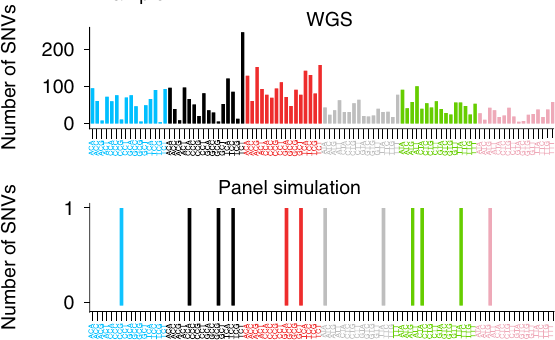
SigMA works with very few SNVs per sample
The same tumor sequenced as a whole genome (top) and downsampled to a panel (bottom). Panel capture leaves most of the 96 trinucleotide channels empty and single counts elsewhere. Five SNVs is the minimum required; below that no assignment is made.
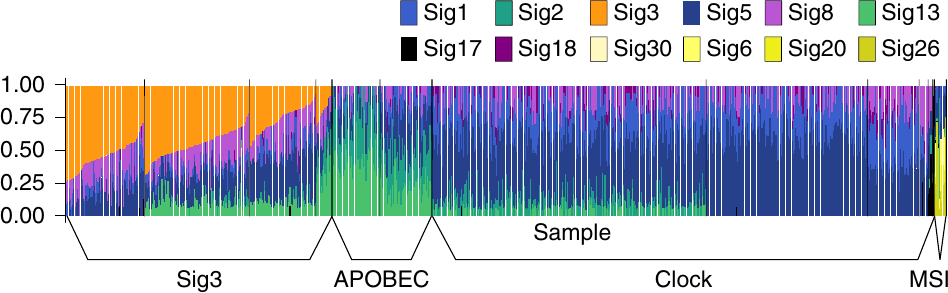
Tumor-type clusters replace de novo decomposition
Whole genomes of the same tumor type are clustered by signature composition. In breast cancer, 730 WGS samples resolve into twelve clusters grouping as Sig3, APOBEC, Clock and MSI. A new sample is compared against these cluster averages rather than decomposed on its own, which is more stable at low mutation counts.
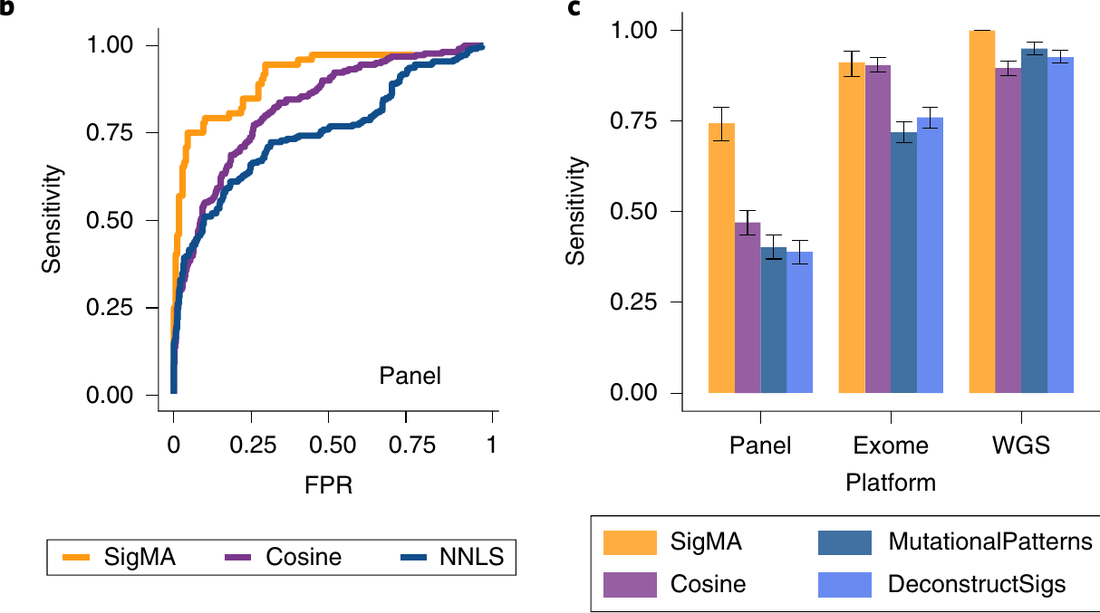
Likelihood-based matching with a multivariate classifier
Cosine similarity is unstable at low counts, where one mutation can shift the angle substantially. SigMA computes the likelihood of the observed mutations under each cluster profile and combines it with cosine similarity and NNLS exposures in a gradient-boosting classifier. On simulated panels this raises sensitivity from below 0.5 to 0.74 at a 10% false-positive rate.
SigMA returns a per-sample score, a threshold set for a target false-positive rate, the matched cluster and its signature exposures; the same run can also classify mismatch-repair deficiency from microsatellite indels. Across simulations and MSK-IMPACT data, Sig3 is called in 38% of ovarian, 27% of osteosarcoma, 16% of breast and 12% of prostate tumors. Cell lines classified HR-deficient respond to PARP inhibitors, and ovarian cancer patients classified HR-deficient showed significantly longer overall survival on platinum. Figures reproduced from Gulhan et al., Nature Genetics 2019.
R -e 'devtools::install_github("parklab/SigMA")'Detecting the mutational signature of homologous recombination deficiency in clinical samples
Gulhan DC, Lee JJ, Melloni GEM, Cortés-Ciriano I, Park PJ (2019)
Nat Genet. 2019 May;51(5):912-919. Epub 2019 Apr 15.
doi: 10.1038/s41588-019-0390-2