

Tau times copy-number gains from bulk tumor sequencing. The clock it reads is mutation multiplicity: how many of a segment's mutations sit on every copy of it, and how many on only one. Segments that come back with the same time are pooled into whole-genome, partial-genome and chromosome-specific doubling events.
The Tau catalog at tau.sigscape.org times whole-genome doubling across 2,703 PCAWG tumors. This page is for the software that produced it, so you can run the same timing on your own samples. The timing rests on mutation multiplicity: a segment that gains a copy carries its existing mutations onto the new copy, while anything arriving later sits on one copy only. Extra copies collect mutations faster, so each class is scaled by the number of copies it sits on before the counts are compared, and mutations are weighted toward SBS1 and SBS5, the clock-like signatures, using the COSMIC v3.2 definitions bundled with Tau.
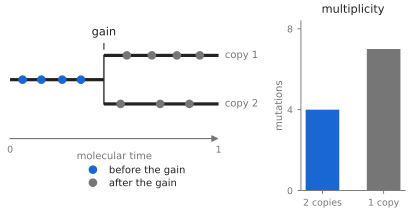
Mutations as clocks
Mutations present before the gain end up on both copies, later ones on a single copy, and the split between them dates the gain.
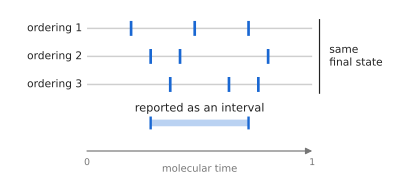
One state, several orderings
Three orders of gains reach the same three-copy, two-copy state. Two of them share a solution, which is weighted twice as heavily.
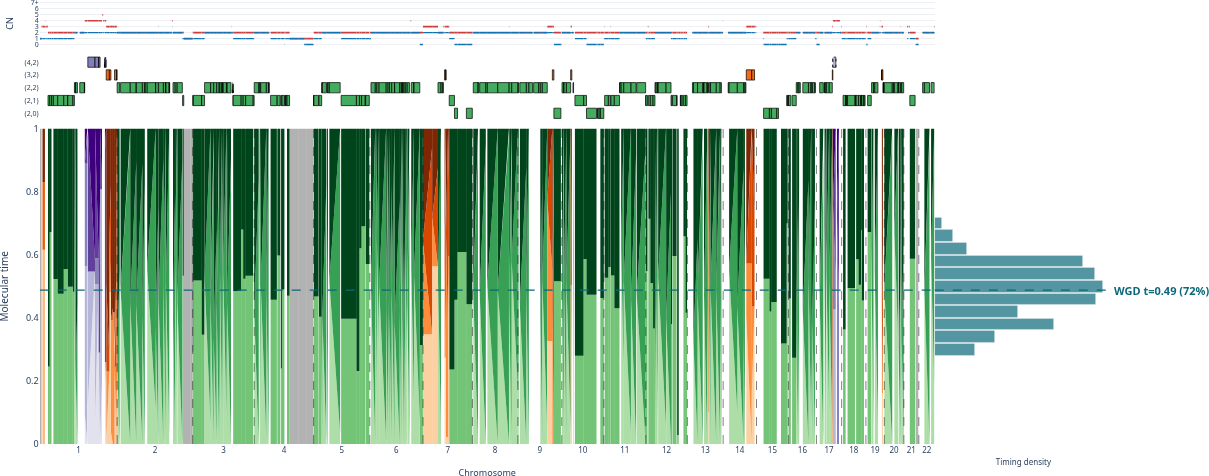
Pooling segments into events
216 segment times for this liver tumor, pooled into one whole-genome doubling at t = 0.49 across 72% of the genome.
Where an ordering leaves a degree of freedom, the result is an interval with an average and bounds, and every candidate Tau tried is recorded with its fit distance. Events come back classified as whole-genome, partial-genome or chromosome specific, with the genome fraction behind each one and bounds from ten bootstrap replicates. Solutions are precomputed for major and minor copy number up to 7, and beyond that for major 10 with minor 2 to catch focal amplifications, the states covering 99.8% of the genome on average and 81% of all segments in the PCAWG consensus calls. On the simulated genome bundled with Tau, all 26 segments are timed and the doubling is recovered at t = 0.29 against a ground truth of 0.30. Across the catalog, 808 of the 2,703 PCAWG genomes carry a whole-genome doubling and 333 a partial one.
git clone https://github.com/gulhanlab/Tau.git && cd Tau && pixi installTau has no paper to cite yet. Until the preprint is out, contact Doga Gülhan about citing it in your work.